
What Is a Project Delivery Method
A project delivery method establishes how an owner, designer, and builder organize their responsibilities to complete a construction project. Some arrangements also include financing, operations, and maintenance (Construction Management Association of America [CMAA], 2025; Federal Highway Administration [FHWA], n.d.-c).
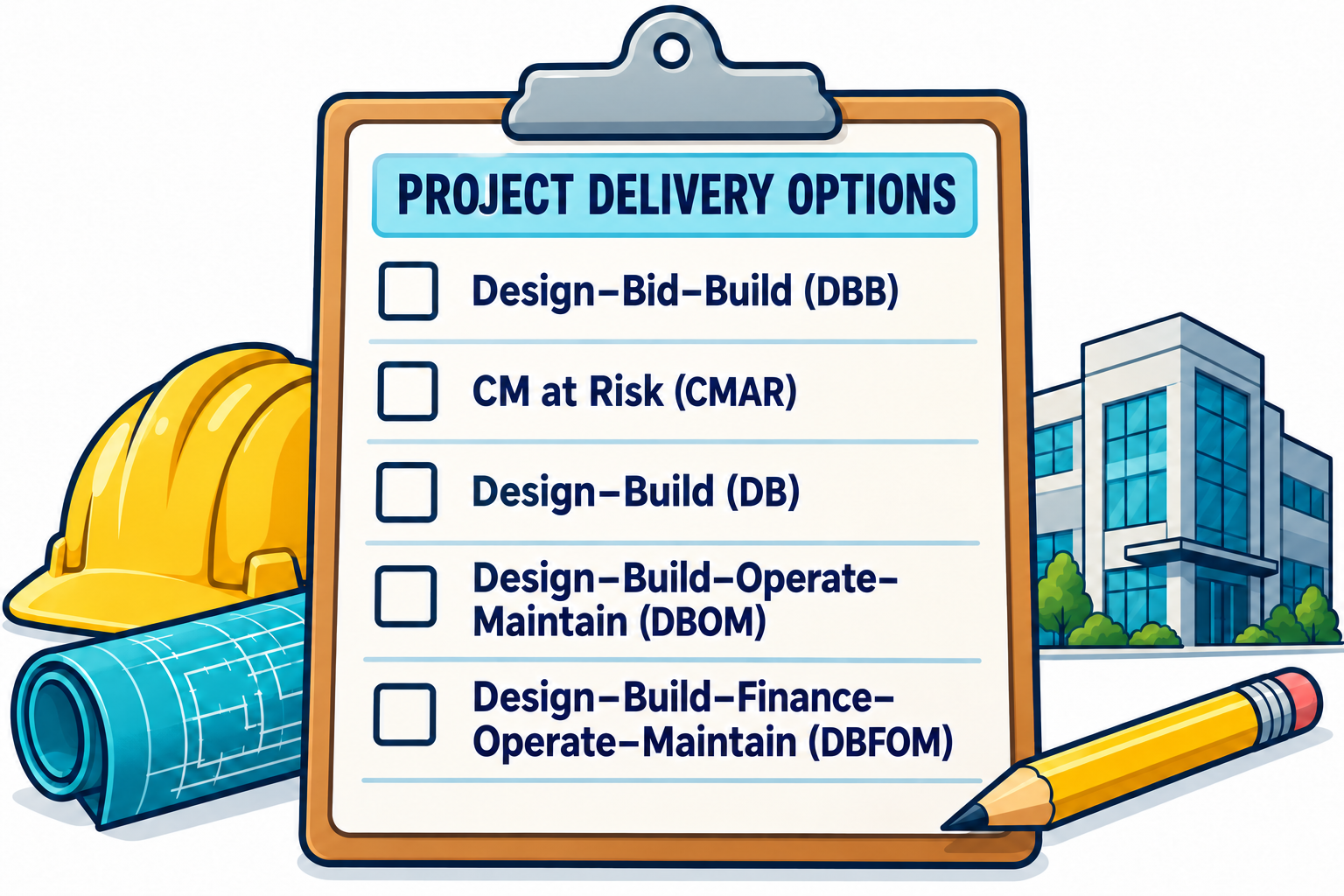
For our third publication, we are explaining five common delivery methods: Design–Bid–Build, CM at Risk, Design–Build, Design–Build–Operate–Maintain, and Design–Build–Finance–Operate–Maintain.
Each approach offers different benefits depending on the project. The following overview explains what the terms mean, how responsibilities differ, and which project conditions may make each approach useful.
Design–Bid–Build
With Design–Bid–Build (DBB), the owner hires a designer to complete the plans, seeks construction bids, and then contracts with a builder. Design and construction remain separate agreements, and the main phases follow a sequence (FHWA, n.d.-b).
This approach can suit projects with a well-defined scope, such as a straightforward office renovation with a settled layout. Contractors price the same completed design, making bids easier to compare. The tradeoff is timing: the selected builder generally contributes after design is complete, so a difficult detail or expensive material may prompt revisions and delay construction.
CM at Risk
Construction Manager at Risk (CMAR) brings the construction manager into planning and design to advise on estimates, scheduling, and constructability. The owner keeps a separate design contract; the CM later takes responsibility for construction, often under a guaranteed maximum price, or GMP (CMAA, 2025).
CMAR can be useful when construction logistics are complex, such as an expansion of an occupied school. Construction input during design can help plan safe access, summer work, and long-lead equipment.
The benefit is practical advice while changes are easier to make. The caution is that a GMP applies to the agreed scope and contract terms. Owner changes and permitted adjustments can still increase it; it is not a promise that every possible cost is covered.
Design–Build
Design–Build (DB) places design and construction under one agreement with a design-builder, giving the owner a single point of contractual responsibility for both (Design-Build Institute of America, n.d.).
DB can suit projects that benefit from coordinated design and construction or an accelerated schedule. On a new warehouse, the team can coordinate loading bays, structural spans, and equipment choices together. Some design and construction activities can overlap, offering potential schedule savings (FHWA, n.d.-b).
The owner must clearly describe capacity, quality, and performance requirements. An integrated team can simplify coordination, but it still needs clear direction and owner oversight.
Design–Build–Operate–Maintain
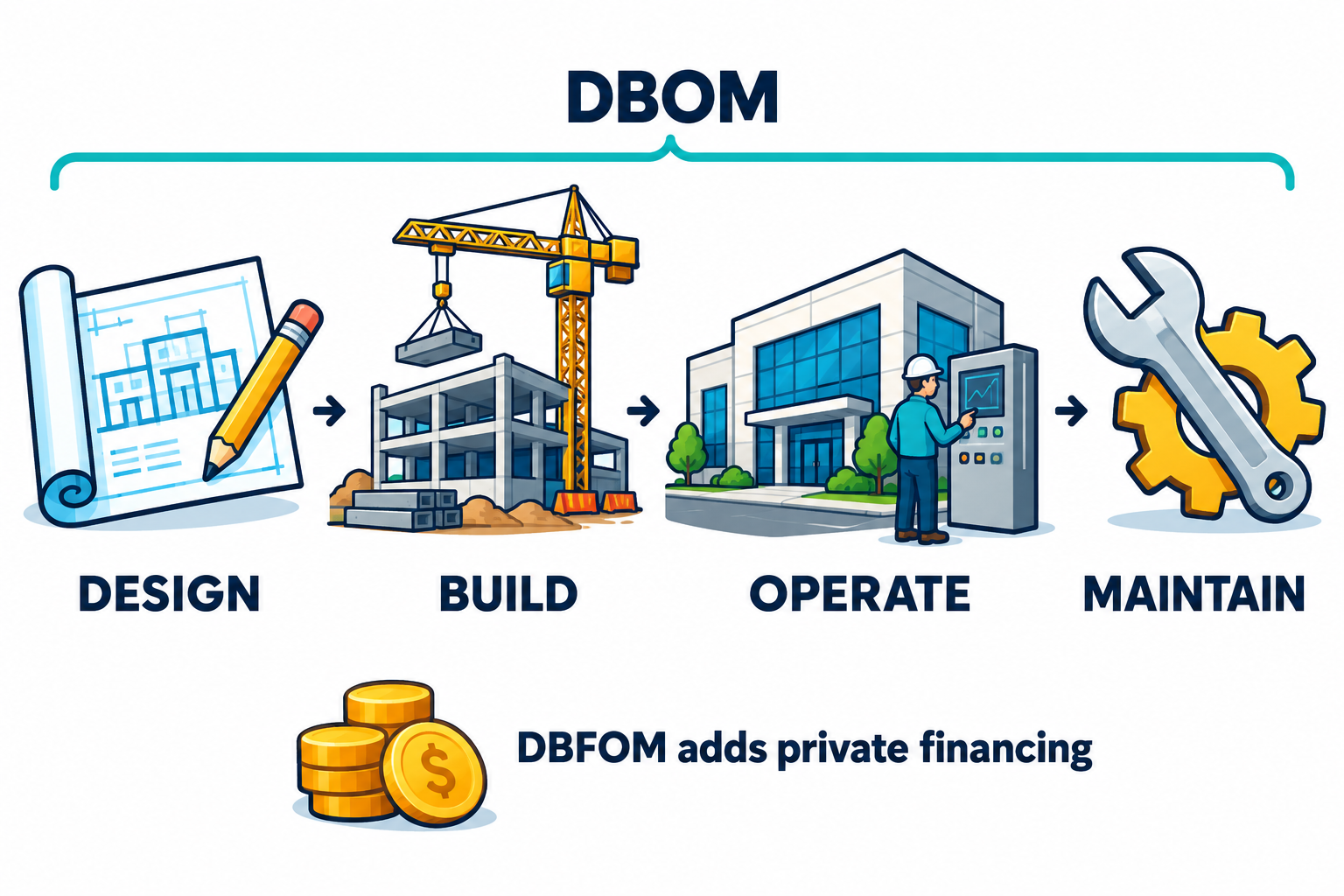
Design–Build–Operate–Maintain (DBOM) extends the agreement into operating and maintaining the completed facility for a defined period. The owner arranges financing separately (FHWA, n.d.-a).
DBOM can suit facilities where reliable service and ongoing upkeep are central to the project, such as a transit system. Because the delivery team also operates and maintains the facility, equipment choices must account for service needs and costs over its life.
The tradeoff is a longer commitment. Owners need measurable service standards, clear maintenance responsibilities, and a plan for the end of the agreement. Operations and maintenance overlap in practice; they are continuing responsibilities.
Design–Build–Finance–Operate–Maintain
Design–Build–Finance–Operate–Maintain (DBFOM) adds private financing to the integrated delivery arrangement. A private partner arranges some or all of the financing and takes on contracted design, construction, operating, and maintenance responsibilities, often through a long-term public–private partnership (FHWA, n.d.-c).
DBFOM may suit large infrastructure projects with a workable long-term payment structure. A highway agreement might repay the partner through toll revenue or public payments tied to keeping the road available at specified standards. Who bears traffic and revenue risk depends on the agreement.
Financing supplies money up front; funding pays the bills over time. Private financing does not make a project free, and public contributions may still be needed. Owners must weigh financing costs and long-term payment obligations against the benefits of the arrangement (FHWA, n.d.-c).
Our Perspective
At Milrot Industries, our goal is to make these delivery options easier to understand and show where each can offer practical benefits.
A clearly defined renovation may benefit from DBB’s comparable bids. A complex expansion may benefit from CMAR’s construction input during design. DB can support close coordination and overlapping work, while DBOM connects delivery to ongoing service. DBFOM adds private financing where a long-term infrastructure arrangement can support it.
No single method is best for every project (CMAA, 2025). These are potential applications, not fixed categories. The differences lie in how responsibilities are assigned and how well that arrangement fits the project’s scope, schedule, and long-term needs.
Thank you for reading our third publication. We hope this overview provides a useful introduction to the different ways construction projects are delivered.
— Milrot Industries
References
Construction Management Association of America. (2025). Understanding your role: CM/PM responsibilities by project delivery method. https://www.cmaanet.org/sites/default/files/resource/CMAA-DeliveryMethods-WhitePaper-03052025.pdf
Design-Build Institute of America. (n.d.). What is design-build? https://dbia.org/what-is-design-build/
Federal Highway Administration. (n.d.-a). Design build operate maintain (DBOM). https://www.fhwa.dot.gov/ipd/alternative_project_delivery/defined/new_build_facilities/dbom.aspx
Federal Highway Administration. (n.d.-b). EDC-2: Design-build. https://www.fhwa.dot.gov/innovation/everydaycounts/edc-2/designbuild.cfm
Federal Highway Administration. (n.d.-c). New build facilities. https://www.fhwa.dot.gov/ipd/p3/defined/new_build_facilities/